The Answer Depends on What Is Going Over It
There is no single “faded enough” threshold. How light the old tattoo needs to go is set entirely by the design going on top — its darkness, its density and its palette relative to what is already there.
That is why the first thing we ask at a fading consultation is not about the old tattoo. It is: what are you having done instead? Without that, any fading target is a guess.
The general rule is that a cover-up design needs to be darker and denser than the ink underneath it, at every point where it sits over the old work. Fading exists to close that gap when the new design cannot manage it on its own. Everything in our cover-up fading service is built around finding the specific point where your design becomes achievable.
When You Do Not Need Laser at All
Some cover-ups genuinely need no fading, and a good studio will tell you so rather than sell you a bundle.
You can usually skip it when the new design is solid, dark and dense — heavy blackwork, dense traditional work with strong black shading, or a large piece with a lot of black mass. When the old tattoo is already light, whether through age, poor original saturation or amateur application. And when the new design comfortably covers the old shape with room to spare, so there is no exposed overhang.
Combine those three and an artist can often work straight over it. That conversation costs you nothing at a consultation and occasionally saves you a full course.
Ask the artist first, not the laser clinic
The person who knows whether your design will cover is the person drawing it. Bring their opinion into the room before you commit to fading sessions, or bring the design and let us assess it together.
When Fading Is Essential
Heavy black outlines. Thick linework is the single most common reason cover-ups fail. Black lines are dense, deeply placed and stubborn, and they will reassert themselves through lighter ink over time even if they look covered on day one.
Fine line or single-needle work. These styles have essentially no covering power. There is not enough pigment in the new design to hide anything, so the old tattoo has to be reduced to almost nothing.
Colour over dark ink. Colour reads translucent over black. A red or blue passage sitting over old black shading will look muddy and dull rather than vibrant. Fading the base is what allows the colour to actually be the colour.
Designs with negative space. Any part of the new design that leaves skin showing is a window onto the old tattoo. Negative space and old ink do not coexist.
Significant overhang. Where the old shape extends beyond the new one, those edges are fully exposed and need proportionally more clearance than anywhere else.
Overhang is the factor people most often miss, so it is worth being explicit. A cover-up hides what sits underneath it and nothing else. If your old piece has a spiky silhouette, trailing linework or a shape the new design does not fully enclose, those exposed sections have to be taken close to clearance regardless of how dark the new tattoo is. In practice that often means the fading target for the edges is much more demanding than the target for the middle, and it is a common reason a piece that looked like a three-session job turns out to be a six.
| New design | Old tattoo | Fading needed |
|---|---|---|
| Heavy blackwork | Mid-weight, aged | Often none |
| Dense traditional colour | Light or faded | Minimal, 3-session bundle |
| Detailed black-and-grey | Solid black or tribal | Moderate, 3–6 sessions |
| Fine line | Anything visible | Substantial, 6 sessions |
| Colour with negative space | Dark or dense | Substantial, 6 sessions |
The Blast-Over Question
A blast-over is tattooing straight over an existing piece with no fading. In some styles it is a deliberate aesthetic — traditional and blackwork artists do it knowingly and the old design showing faintly is part of the look.
Used as a shortcut to avoid laser, it is a different thing. The failure mode is not usually immediate. It is eighteen months later, when the new ink has settled and lost a little density and the old black lines start showing through again. By then covering it a second time is much harder, because you now have two tattoos’ worth of pigment in the same skin.
If you are being offered a blast-over on a piece with heavy black lines, ask specifically what it will look like in two years, not what it will look like the week after.
Judging It Mid-Course
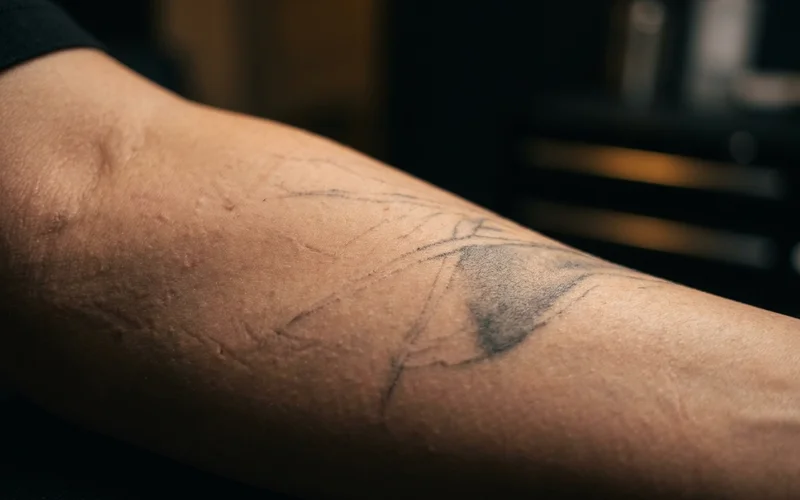
Halfway through a fading course, the skin looks patchy and grey rather than uniformly lighter. Black breaks up unevenly, so you get areas that have lifted well next to areas that have barely moved.
This is normal, and it is exactly what an artist needs to see. What they are judging is not how nice it looks — it is whether the remaining density is low enough for their design.
Which is why we bring the artist into the assessment rather than deciding alone. Sometimes they look at it after three sessions and say that is enough. Sometimes they want one more. Our guide on planning it with your artist covers how to run that conversation, and if you are still deciding between covering and clearing entirely, whether to fade or fully remove is the fork to think through first.