The Honest Answer
Yes, it stings. Most people describe it as being flicked hard with an elastic band, or as tiny sparks against the skin.
What matters far more than the intensity is the duration. Each area is over in seconds to a couple of minutes. A small wrist piece can be done in under a minute. Even a large back piece is broken into short passes with breaks between them, rather than one sustained ordeal.
We are not going to tell you it is painless — that would be nonsense, and you would find out in about four seconds. What we will say is that almost nobody stops a course because of the pain, and plenty of people are surprised at how much less it is than they had braced for. If you want to feel it for yourself before committing to anything, book a free consultation and patch test — the patch test gives you a genuine sample of the sensation with no obligation attached.
Why Photoacoustic Lasers Hurt Less
The pain reputation tattoo removal carries was earned by older thermal lasers, and it was earned fairly.
Nanosecond Q-switched lasers work partly by heating pigment until it breaks apart. That heat does not stay neatly inside the ink particle — it spreads into the surrounding skin, which is what produces the burning sensation, the heavier blistering and the longer recovery those machines were known for.
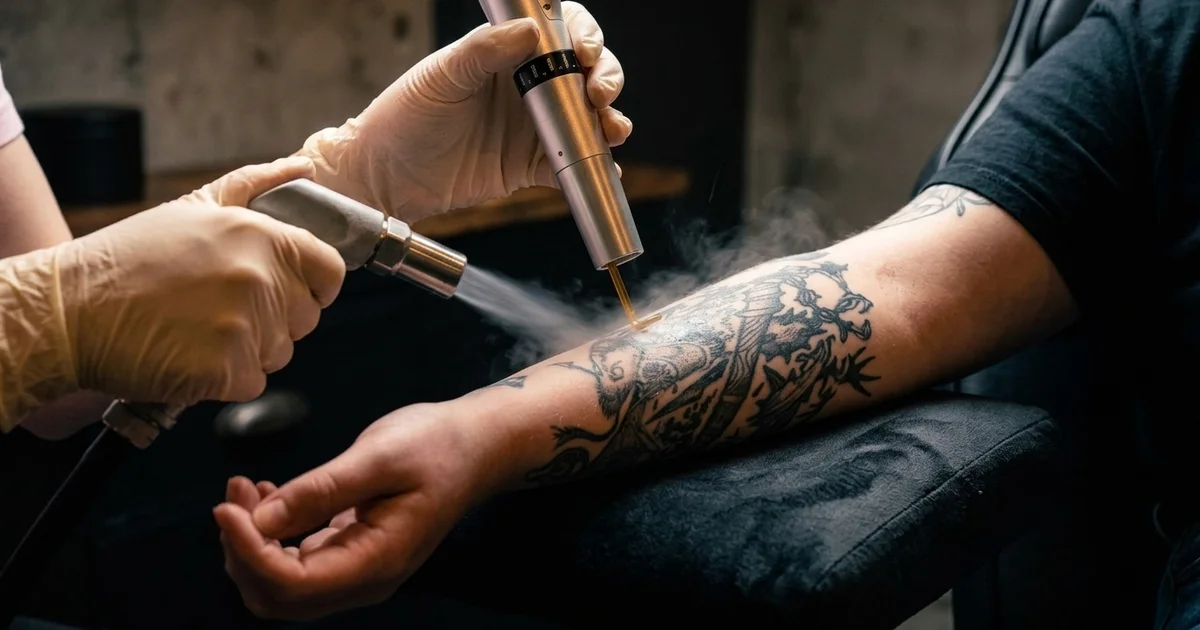
PicoWay fires picosecond pulses, roughly a thousand times shorter. The energy is delivered and gone before it has time to become heat. Instead it creates a photoacoustic shockwave that fractures the pigment mechanically.
The practical result is that you feel a sharp snap rather than a burn, and the skin around the ink takes far less thermal insult. That difference shows up in comfort during the session and in how the area feels for the rest of the day. It is also part of why the scarring risk is lower than most people assume.
What cryo-cooling actually does
A cryo unit blows chilled air onto the treatment area before, during and after each pass. Cold numbs the nerve endings and takes the edge off the thermal component of the sensation. It runs on every session as standard here, not as a paid extra, and most clients say it is the single thing that makes the session comfortable.
Which Areas Hurt More
Pain is not evenly distributed, and knowing where yours sits helps you plan.
More sensitive: ribs, sternum, ankles, tops of the feet, wrists, inner arm, elbow, neck and anywhere the skin sits directly over bone with little padding.
Less sensitive: outer thigh, upper arm, shoulder, back, calf and buttock, where there is more tissue between the skin and the bone.
Two other things move the dial. Dense, saturated black areas absorb more energy and register more sharply than sparse line work. And your own state matters — going in tired, hungover, dehydrated or having had a lot of caffeine reliably makes it worse. Eat something, sleep, and skip the third coffee.
What It Feels Like Afterwards
The sensation immediately after treatment is closest to sunburn: hot, tight and tender to touch. That peaks within the first few hours and settles substantially by the next day.
You may see frosting — a white bloom over the treated area — within seconds of the pass. It fades in about twenty minutes and is a good sign, not a burn. Swelling and pinkness follow, and blistering is normal on some people and some areas.
Paracetamol is fine if you want it. Avoid ibuprofen and other anti-inflammatories immediately after treatment where you can, since the inflammatory response is part of how your body clears the fragmented ink. Keep the area cool, covered and completely untouched — the single most important rule is not picking at blisters, because that, rather than the laser, is what causes most of the scarring people fear.
How to Make the Session Easier
A few things reliably help, and none of them cost anything.
Eat beforehand. Arriving on an empty stomach is the most common reason someone feels lightheaded, and it has nothing to do with the laser.
Sleep and hydrate. Both raise your pain threshold measurably. Going in tired and hungover is the worst version of this appointment.
Go easy on caffeine. It heightens sensitivity and adds a jittery edge that makes everything feel sharper.
Speak up. We stop when you ask. Working in shorter bursts with breaks costs a couple of extra minutes and makes a large piece far more tolerable — there is no prize for sitting through it silently.
Book sensibly. For anyone who is anxious, a morning appointment usually beats spending the whole day thinking about it.
Numbing cream is worth raising at your consultation rather than applying before you arrive. Topical anaesthetics can affect how the skin responds and how we read it, so we would rather agree it in advance. Most people find the cryo-cooling makes it unnecessary.
Most people are back to normal within a few days and would describe the whole thing as very manageable. If pain is your main hesitation, the patch test is the answer: it takes seconds, costs nothing, and tells you exactly what you would be signing up for. Here is what happens at your first appointment.