
The Short Answer
Laser tattoo removal works by breaking tattoo ink into pieces small enough for your own immune system to carry away. The laser does not lift ink out of the skin, dissolve it, or burn it off. It shatters it, and your body does the rest over the following weeks.
That single fact explains almost everything else about the process: why it takes several sessions, why you wait six to eight weeks between them, and why the result keeps improving after you have left the studio.
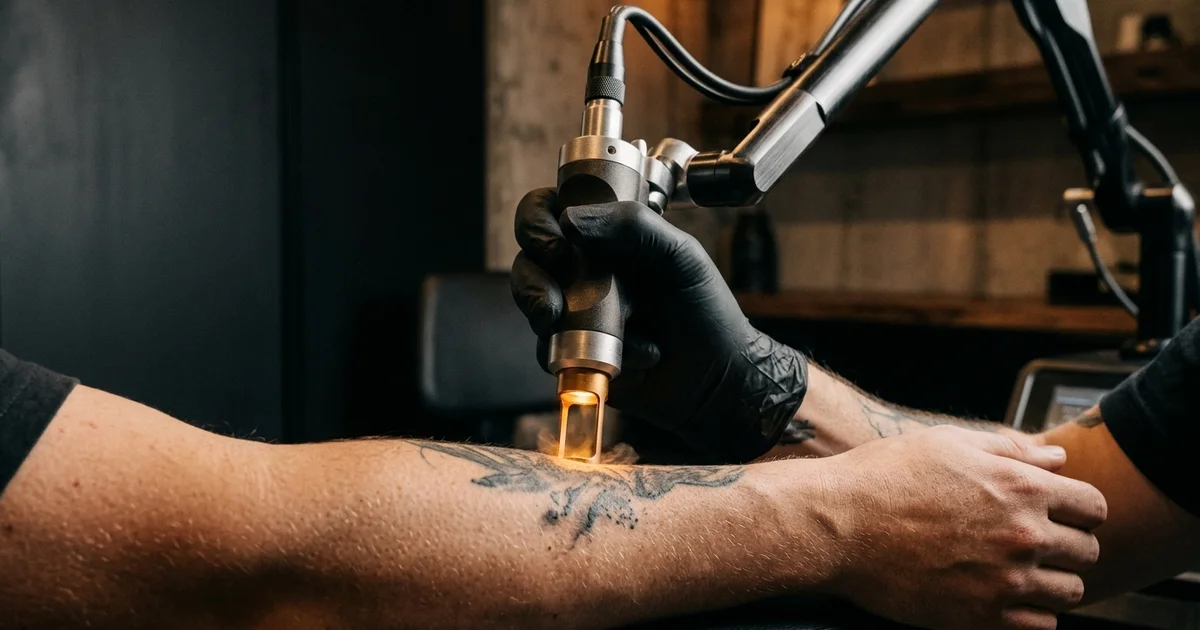
The system we use for PicoWay laser tattoo removal in London fires pulses measured in picoseconds — trillionths of a second. At that speed the energy behaves less like heat and more like a mechanical shock, which is the difference that makes modern removal both more effective and more comfortable than it used to be.
Why Tattoos Are Permanent in the First Place
When you get tattooed, the needle deposits pigment particles into the dermis, the layer below the surface. Your immune system immediately recognises them as foreign and tries to remove them. It fails, because the particles are too large for the cells doing the work to pick up and transport.
So they stay put. That stalemate is what makes a tattoo permanent — not that the ink is indestructible, but that it is too big to move.
Laser removal changes the size of the problem. Break each particle into a cluster of much smaller fragments and the same immune cells that failed for years can suddenly do their job. You are not overpowering your body’s clearance system; you are giving it something it can actually handle.
The one-line version
The laser makes the ink smaller. Your body removes it. Everything else — session counts, intervals, colour differences — follows from that.
Photoacoustic Shockwaves vs Heat
Older Q-switched lasers fire nanosecond pulses — billionths of a second. That is fast, but slow enough that a meaningful amount of the energy converts to heat before the pigment breaks apart. That heat spreads into the surrounding skin, which is where the blistering, discomfort and scarring risk of first-generation tattoo removal came from.
Picosecond pulses are roughly a thousand times shorter. The energy arrives and is gone before it has time to become heat. Instead it creates a photoacoustic shockwave — a pressure wave that fractures the pigment mechanically.
Two things follow from that. First, the surrounding tissue takes far less thermal damage, so the treatment hurts less and heals faster. Second, the fragments it produces are finer. Finer fragments are easier for your immune system to clear, which is why picosecond systems typically need fewer sessions than nanosecond ones to reach the same result.
Wavelength matters alongside pulse width. Different ink colours absorb different wavelengths, so a laser with only one wavelength can only efficiently treat part of the colour range. PicoWay runs both 532nm and 1064nm, which is why some ink colours are harder to remove on single-wavelength machines but treatable on ours.
What Happens During and After a Session
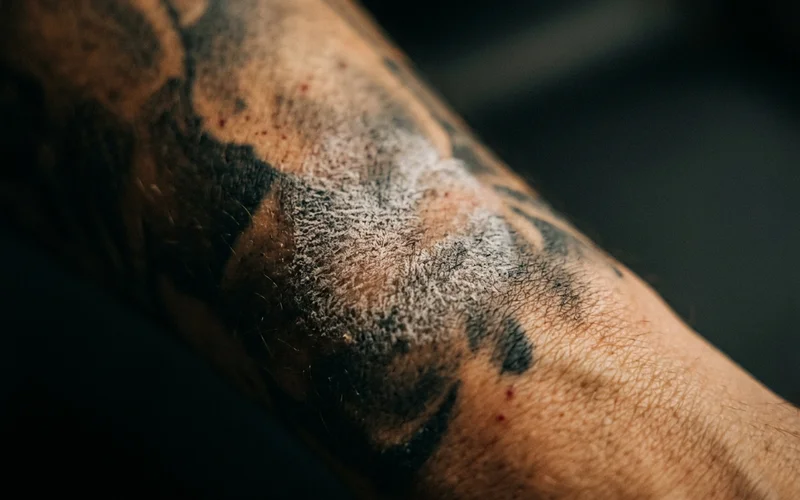
During treatment you will see the treated area go white almost immediately. That is called frosting, and it is carbon dioxide and nitrogen gas released as the pigment fragments. It fades within about twenty minutes and is a good sign — it means the energy reached the ink.
Over the following days the area is pink and slightly swollen, sometimes with blistering, and then it scabs and settles. Underneath, the real work is happening: macrophages are collecting the ink fragments and moving them into the lymphatic system, which processes them out of the body.
That clearance is not fast, and it cannot be rushed. Six to eight weeks is not an arbitrary safety margin — it is roughly how long your body needs to finish carrying away one session’s worth of fragmented pigment. Treating sooner means firing energy at ink your body is still dealing with, on skin that has not fully recovered.
It also means the tattoo carries on fading while you are doing nothing at all. The lightest your tattoo looks after any given session is usually six or seven weeks later, not the day after. If you want a sense of the full timeline, our guide to how many sessions it takes covers the variables that drive the count.
Why No Laser Is Instant
Every so often someone asks whether a more powerful machine could do it in one go. It is a reasonable question and the answer is a firm no, for a reason that has nothing to do with the laser.
The bottleneck is not how much pigment can be fragmented. It is how much fragmented pigment your body can carry away, and that rate is fixed by your own physiology. Firing more energy in a single session does not give your lymphatic system a bigger appetite; it just adds thermal and mechanical stress to skin that then has to recover from it.
There is a second limit. The laser reaches the pigment nearest the surface first. Ink sitting deeper is partly shielded by the ink above it, so it only becomes properly treatable once that upper layer has been fragmented and cleared. Each session peels back a layer. You physically cannot reach the bottom of a dense tattoo on the first pass, however much power you use.
This is also why a course cannot be compressed into a fortnight for someone in a hurry. The interval is not a booking convenience — it is the part of the process where the tattoo actually leaves your body.
None of this requires you to understand the physics to get a good outcome. But knowing that the laser is a fragmentation tool rather than an eraser explains why a good technician spaces sessions properly, starts with a patch test, and refuses to promise you a number before seeing the tattoo.