Why Tribal Work Is Its Own Category
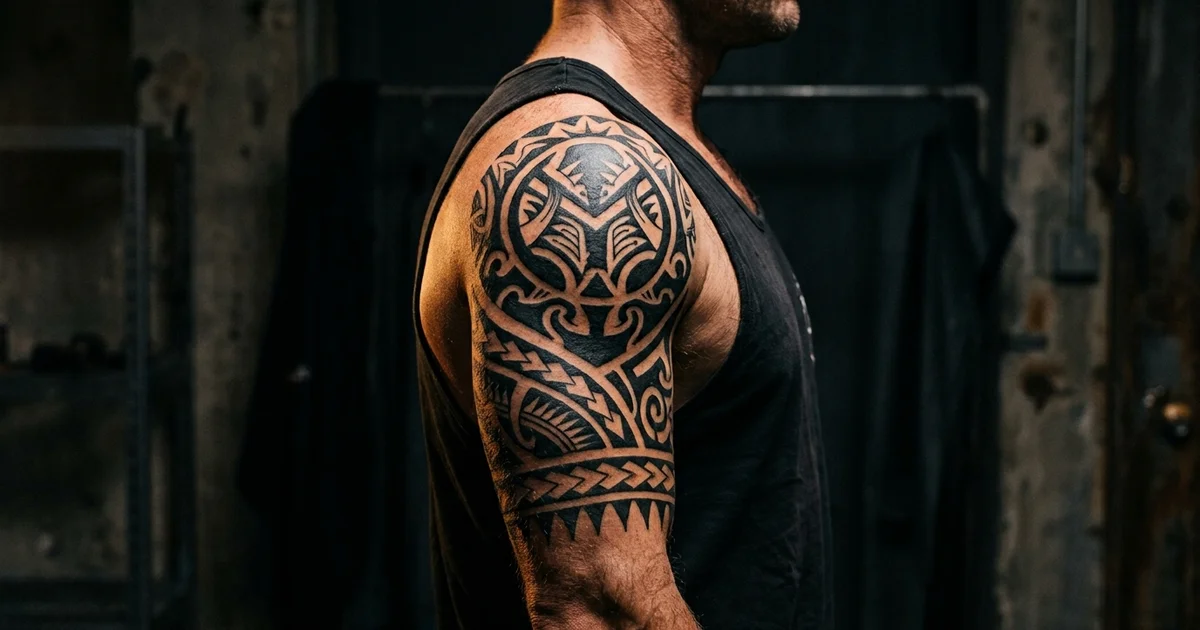
A large proportion of the fading work we do is 1990s and 2000s tribal — solid black armbands, shoulder pieces and lower-back designs that have long since stopped feeling like the right decision.
It is worth treating as its own scenario because it behaves differently from other tattoos. The good news first: black is the easiest colour to remove. It absorbs energy across the whole spectrum, so every pass reaches it efficiently and the 1064nm wavelength does the work reliably.
The catch is volume. Tribal designs are solid fill, which means a huge amount of pigment packed into every square centimetre. You are not fighting a difficult colour, you are working through a large quantity of an easy one. That is why our tattoo fading service usually quotes tribal work at the upper end of the bundle range.
How Block Shading Behaves as It Lightens
Line work and block shading fade differently, and knowing this in advance saves a lot of anxiety around session three.
Line work thins. The edges soften, the line gets narrower and greyer, and it recedes fairly evenly. It looks like something being erased.
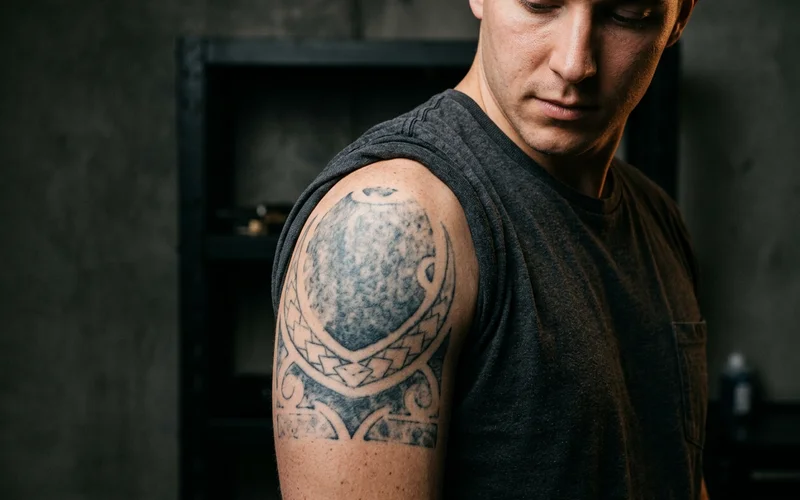
Block shading breaks up. Instead of the whole area lightening at once, it fragments into a mottled pattern — patches that have cleared well next to patches that have barely shifted. Old tribal often lightens fastest at the edges of a solid area and slowest in the centre, where the ink was packed most heavily.
The result mid-course is a grey, blotchy version of the original design. It genuinely looks worse than the tattoo did before you started, and that is the point at which people message us worried. It is normal, it evens out as the course continues, and an artist reads that patchiness as useful information rather than a problem.
Migrated ink is your friend
Twenty-year-old tribal that has blurred and spread often clears faster than crisp modern blackwork. The pigment has already dispersed, your immune system has been chipping away at it for two decades, and there is simply less concentrated ink left to fragment.
Old Ink Behaves Differently
That last point deserves expanding, because it is the one piece of good news attached to having an outdated tattoo.
Every tattoo starts fading the day it is done. Your immune system never actually stops trying to clear it; it just cannot keep up. Over twenty years it removes a meaningful fraction of the pigment and the rest spreads slightly as the particles shift within the dermis. Lines soften, edges blur, solid black goes slightly grey-blue.
For removal, all of that helps. There is less total pigment left, it is less densely concentrated, and it is more accessible to the laser. Two identical tribal armbands, one done in 2003 and one done last year, are not the same job — the older one will usually clear in fewer sessions despite looking messier.
The exception is depth. Some older work, particularly heavy-handed pieces, was placed deeper than modern technique would place it. Deep pigment reads bluer through the skin and takes more passes to reach. We look for that at the patch test rather than assuming age alone predicts the outcome.
What It Realistically Takes
For cover-up fading on dense black or tribal work, expect the six-session bundle rather than the three. Some pieces get there in four. Heavily saturated modern blackwork on a poor-circulation area can need more.
| Piece | Typical fading sessions | Calendar to artist-ready |
|---|---|---|
| Aged, blurred 1990s tribal | 3–4 | ~5–7 months |
| Mid-weight solid black armband | 4–6 | ~6–10 months |
| Modern saturated blackwork | 6+ | ~9–12 months |
| Any of the above, on ankle or foot | Add 1–2 | Add 2–3 months |
Two things push the number up specifically for tribal. Thick outlines around the solid fill are the last thing to go and the first thing to show through a cover-up. And overhang matters more here than on most pieces, because tribal designs have distinctive spiky silhouettes that are hard for a new design to fully enclose — any exposed point needs proportionally more clearance.
Our guide to how many fading sessions to expect covers the full set of variables if you want to place your own piece on that scale.
What This Means for the New Design
The practical consequence of tribal being dense is that it constrains what you can put over it more than most old tattoos do.
Dark, dense new designs work best. Heavy black-and-grey realism, dense traditional work, or large-scale blackwork can absorb what remains after a moderate fade. Fine line work over old tribal is the hardest ask in cover-ups and needs the old piece taken almost to clearance.
Colour is the other consideration. Colour over residual black reads muddy, so if your new piece is colour-led, the fade has to go further than it would for a black-and-grey design of the same size.
This is exactly the conversation to have with your artist before the first laser session rather than after the third. What they need is a clear answer to “how light can you get it and by when”, and what we need from them is “here is how light it has to be”. Our guide on coordinating with your artist covers how to run that properly.
Bring the tribal piece and whatever reference you have for the replacement. Half of that conversation happens in about five minutes once we can both see the actual skin.