The Honest Range
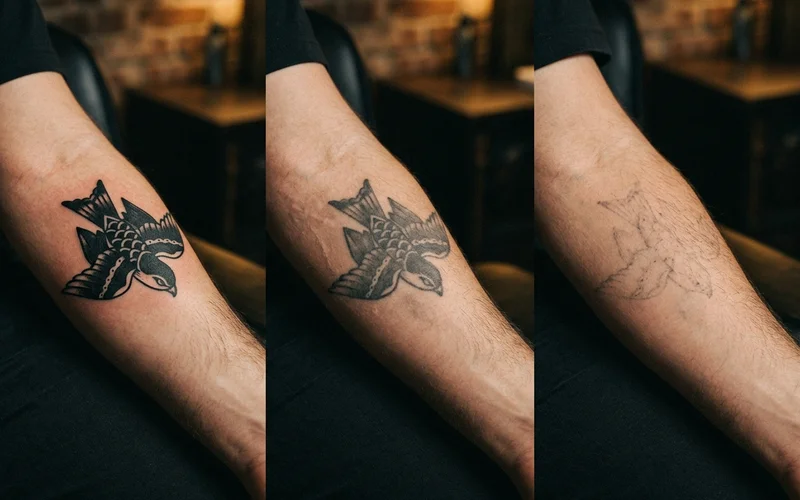
Most tattoos need somewhere between five and ten sessions for complete clearance. Some clear in three. Some need fifteen or more.
Anyone who gives you a specific number before looking at your tattoo is guessing, and any clinic that commits to “six sessions guaranteed” over the phone is either lucky or setting up a conversation you will not enjoy having in month eight.
What we can do is be specific about what drives the number, so you can form a realistic expectation of where in that range your tattoo probably sits. That is what this guide covers, and it is also exactly what your free consultation is for. If you want the pricing side of this, our fixed-price complete removal packages are built so that this number affects how long you are with us rather than what you pay.
The Seven Things That Actually Decide It
Ink density. The single biggest factor. A solid block of packed black holds vastly more pigment per square centimetre than fine line work covering the same area. Density, not size, is what adds sessions.
Depth. Professional tattoos are placed at a consistent, relatively deep level. Amateur and stick-and-poke work is usually shallower and more uneven, which often means faster clearance — one of the few advantages of a badly done tattoo.
Colour. Black absorbs across the spectrum and clears most readily. Reds and oranges respond well to the 532nm wavelength. Green and blue are the historically stubborn pair. White and light cosmetic pigments are the genuine hard cases.
Age. Older ink has already been partially cleared by your immune system over the years, so there is less pigment left to fragment. A twenty-year-old tattoo will typically clear faster than one done last spring.
Body location. Circulation drives clearance. Chest, back and upper arm have strong lymphatic flow and clear fastest. Hands, feet, ankles and the lower leg are furthest from the heart with the weakest flow, and they consistently take longer.
Skin type. Melanin-rich skin is treated with the 1064nm wavelength at conservative energy settings with longer intervals. That is the safe protocol, and it can stretch the calendar without changing the eventual outcome.
Your immune system. Two people with identical tattoos can clear at noticeably different rates. Smoking, in particular, is well documented as slowing clearance.
Why “it depends” is not a dodge
Every one of those seven variables is visible or assessable at a consultation. That is why we quote after seeing the tattoo rather than over the phone — and why we run a patch test before agreeing a plan.
How PicoWay Changes the Maths
PicoWay clears ink in up to 50% fewer sessions than traditional nanosecond lasers. That is not marketing arithmetic; it follows from how the pulse behaves.
A picosecond pulse fragments pigment into smaller pieces than a nanosecond pulse does. Smaller fragments are easier for your immune system to pick up and transport, so more ink leaves per session. Fewer passes are needed to reach the same endpoint.
The dual 532nm and 1064nm wavelengths matter too. On a multi-colour piece, a single-wavelength laser efficiently treats only part of the palette and stalls on the rest — which is where “we got most of it out but the green would not shift” comes from. Two wavelengths mean the whole piece keeps moving.
| Factor | Older Q-switched laser | PicoWay picosecond |
|---|---|---|
| Pulse width | Nanoseconds | Picoseconds |
| Fragment size | Coarser | Finer |
| Typical session count | Baseline | Up to 50% fewer |
| Blue and green ink | Often stalls | Treated with 532nm/1064nm |
| Heat to surrounding skin | Higher | Substantially lower |
Sessions, Intervals and Calendar Time
The number people actually care about is not sessions — it is months. Session count multiplied by interval is the real answer.
At six to eight week intervals, an eight-session course runs roughly twelve to sixteen months. A three-session fading course runs four to six. Add the final clearing period after your last session, because the ink carries on lifting for weeks afterwards.
Those intervals are not padding. The laser fragments the ink; your lymphatic system removes it, and that takes time. Coming back at three weeks means treating skin that is still recovering and ink that is still being carried away — more irritation, no faster result. Our guide to what healing looks like between sessions walks through what your skin is doing during that gap.
There is one more reason the number matters less here than it does elsewhere. On a per-session pricing model, every extra session is another invoice, so a low quote up front and a long course later is a genuinely expensive surprise. On a fixed-price package the risk sits with us instead — worth reading if you are comparing clinics, because how fixed pricing compares to per-session billing is usually the difference between two quotes that look similar on paper.
Why Only a Consultation Gives You a Real Number
Photographs are genuinely poor at answering this. They flatten density, they lie about colour under different lighting, and they tell us nothing about depth — which is one of the two biggest drivers of the count.
In person we can see how saturated the pigment actually is, whether the linework was placed deeper than the shading, whether the piece has migrated with age, and how your skin sits on the Fitzpatrick scale. Then the patch test adds the one thing no visual assessment can give: how your specific ink behaves at a specific energy, and how your skin responds to it a few days later.
That is why we quote after seeing the tattoo rather than over the phone, and why we would rather give you a range with caveats than a confident single number that is wrong. A clinic that commits to “six sessions” from a photo has told you something about their sales process, not about your tattoo.
Bring the tattoo in and we will give you a range we actually believe, plus the honest caveats about which parts of it might be stubborn.