The Direct Answer
Yes. Laser tattoo removal is safe on dark skin, with the right wavelength and the right settings.
If you have been turned away by a clinic, or warned off by someone who “does not treat skin like yours”, what you almost certainly ran into was a limitation of their equipment. A laser without a 1064nm wavelength genuinely should not be used on melanin-rich skin, and a clinic that only has shorter wavelengths is making the correct call by declining. That is a statement about their machine, not about you.
The reason this matters is that removal on deeper skin is entirely routine when the protocol is right. It is one of the reasons we chose PicoWay for PicoWay removal for all skin types — the 1064nm wavelength is the workhorse for exactly this, and it is not an add-on we sometimes use, it is the standard tool for black ink on any skin tone.
The Fitzpatrick Scale and Where the Risk Sits
The Fitzpatrick scale classifies skin by how it responds to UV exposure, from type I (very fair, always burns) through to type VI (deeply pigmented, never burns). It is a rough tool, but it is the standard shorthand for laser protocol decisions.
The relevant issue for types IV to VI is competition for the laser’s energy. Melanin absorbs light, and so does tattoo ink. If the wavelength you fire is one melanin absorbs strongly, a meaningful share of that energy is taken up by the surrounding skin instead of by the pigment you are targeting.
Two problems follow. The ink gets less energy than intended, so clearance slows. And the skin gets more energy than intended, which is what drives pigmentation change and, at the extreme, blistering and textural damage.
So the risk is real. It is just entirely manageable, because it is a function of wavelength and energy — both of which are choices, not fixed constraints.
Why 1064nm Is the Right Wavelength
Melanin absorption drops steeply as wavelength increases. At 532nm — the wavelength used for red and orange inks — melanin absorption is high, which is why that wavelength is used cautiously and sparingly on deeper skin.
At 1064nm, melanin absorption is substantially lower. The energy passes through the epidermis with far less interference and is absorbed preferentially by the dark pigment sitting in the dermis. That selectivity is the entire basis of safe treatment on melanin-rich skin.
Fortunately, 1064nm is also the wavelength that treats black ink best, and most tattoos on any skin tone are predominantly black. The right tool for your skin and the right tool for your ink are usually the same tool.
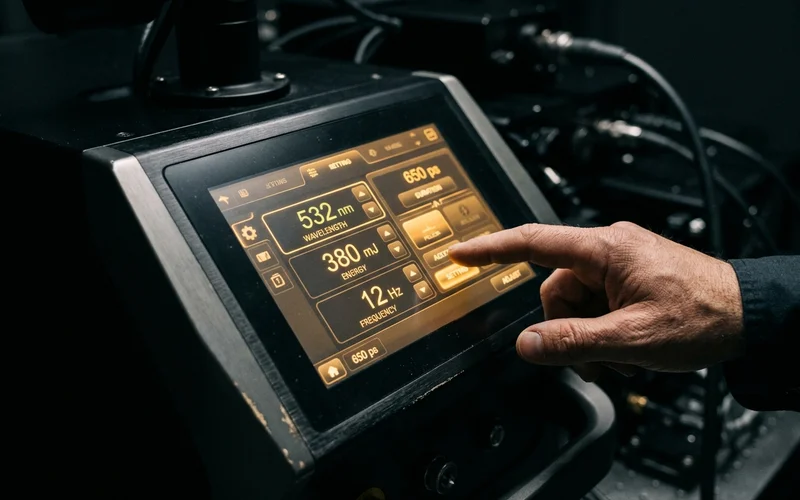
Where a piece contains reds, oranges or warm tones that genuinely need 532nm, we treat those areas selectively, at lower energy, and with a longer interval afterwards. Sometimes we accept a slower result on those specific colours in exchange for keeping the skin safe. That trade-off gets discussed with you rather than made silently.
| Wavelength | Melanin absorption | Best for | Use on Fitzpatrick IV–VI |
|---|---|---|---|
| 532nm | High | Red, orange, warm tones | Selective, low energy, longer intervals |
| 1064nm | Low | Black, dark blue, most body ink | Primary wavelength, routine use |
The Honest Risk Discussion
Post-inflammatory hyperpigmentation (PIH) is the most common issue: the treated area temporarily darkens. It is an inflammatory response and it is genuinely more likely on deeper skin. It typically fades over several months. Sun exposure during that window is the biggest thing that prolongs it.
Hypopigmentation — the treated area coming back lighter — is less common but more visible when it happens on deeper skin, because the contrast is greater. It is usually temporary, with melanocytes recovering over months. It is strongly associated with over-aggressive energy settings, which is precisely why conservative protocols matter here.
Keloid tendency is worth flagging separately. If you keloid — raised scar tissue that grows beyond the original wound boundary — tell us at consultation. It is not automatically a bar to treatment, but it changes how we approach the patch test and how conservatively we set energy. Our guide to scarring and pigmentation risk covers this in more depth.
None of these are exotic. They are the standard risk set for laser work on melanin-rich skin, and every one of them is reduced by the same three things.
The three-part protocol
Conservative energy. Longer intervals — eight to twelve weeks rather than six to eight. And a patch test that we actually wait to assess rather than treating over on the same visit.
Why the Patch Test Matters More Here
On any skin tone, the patch test tells us how your ink responds. On deeper skin it also tells us how your skin responds, and that second answer is the one that shapes the whole course.
We treat a small area, then let it settle properly before doing anything else. What we are looking for is not just whether the ink fragmented — it is whether the surrounding skin showed any pigment shift, how quickly it settled, and whether the energy we used was comfortable for it.
From that we set your working energy, decide your interval, and give you a realistic timeline. It usually means a slower course than someone with type II skin would have. It does not mean a worse result — the ink clears just as completely, it just gets there on a longer calendar.
What to Ask Before You Book Anywhere
Five questions will tell you more than any amount of website copy, and they work on any clinic.
“Does your laser have a 1064nm wavelength?” If the answer is no, or vague, that is the end of the conversation for melanin-rich skin.
“What is your protocol for Fitzpatrick V or VI?” You want to hear about conservative energy, longer intervals and a patch test — not “it is the same for everyone”.
“Do you patch test and wait before the first full session?” Treating on the same day as the assessment skips the step that matters most here.
“How many clients with my skin tone have you treated?” Experience with deeper skin is a different skill from experience with lasers.
“What does post-inflammatory hyperpigmentation look like, and how do you manage it?” A clinic that will not discuss the risk honestly is not the clinic to manage it.
A good answer to all five is more reassuring than any brand name on the machine. A clinic that gets defensive about any of them has told you what you needed to know.
If someone has told you your skin rules removal out, get a second opinion from a clinic that runs 1064nm. Book a free patch test and find out properly rather than taking a machine’s limitation as a verdict on yours.